

For years, contact centers have been built around a familiar model: customers call, an IVR routes the interaction, and a human agent handles the conversation. That model worked when call volumes were predictable, customer expectations were lower, and support interactions were mostly limited to phone calls.
That world has changed.
Customers now expect immediate responses, natural conversations, personalized support, and consistent service across voice, chat, messaging, and digital channels. At the same time, contact centers are dealing with rising operational costs, agent shortages, increasing call volumes, and complex customer journeys.
This is where AI voice agents are reshaping CCaaS platforms.
Rather than functioning as simple automated phone menus, modern AI voice agents can understand natural language, maintain conversational context, access enterprise data, execute workflows, and transfer complex interactions to human agents when necessary.
The result is a significant shift in the contact center industry—from call routing and scripted automation to intelligent, conversational, and action-oriented customer engagement.
From Traditional IVR to Intelligent Voice Automation
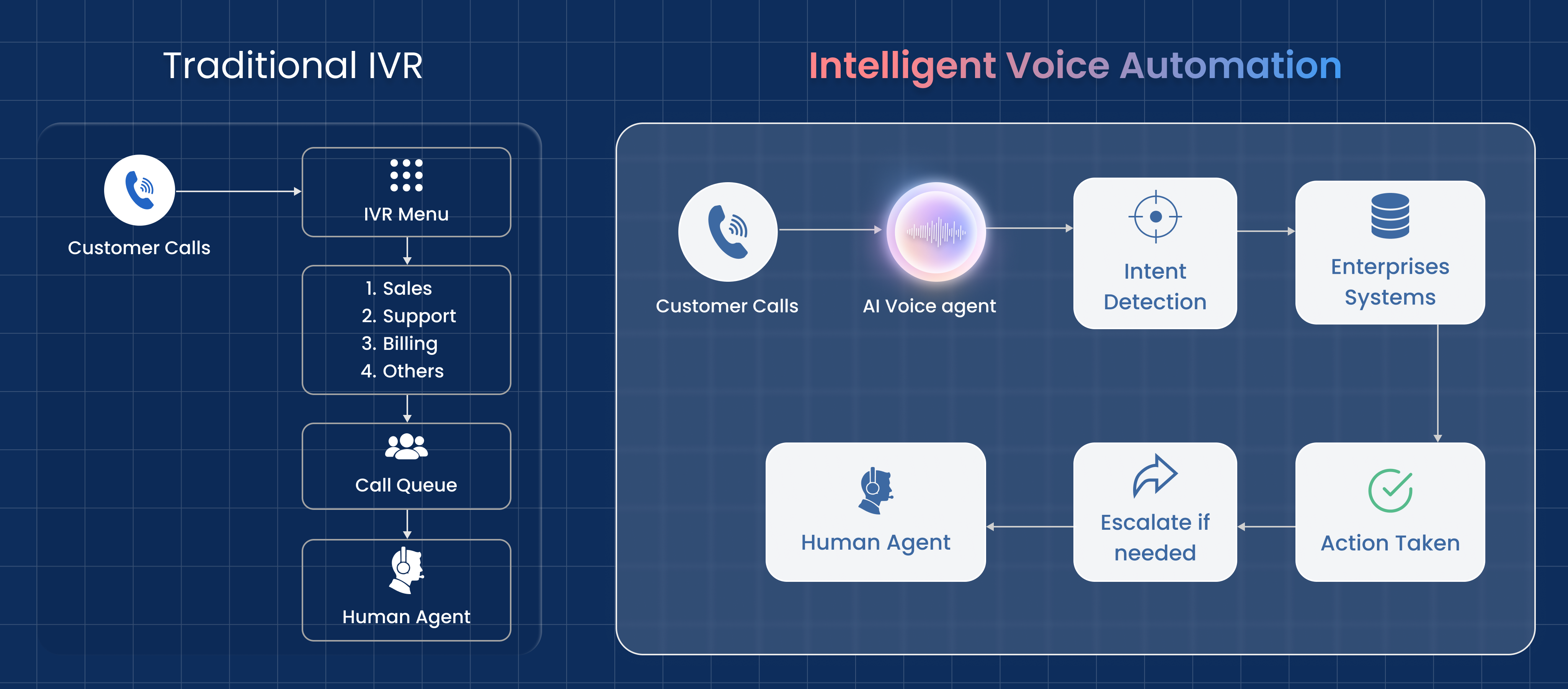
Traditional Interactive Voice Response (IVR) systems typically depend on predefined menus.
“Press 1 for sales. Press 2 for support.”
While this system is reliable for basic routing, it creates friction when customers need help with complex issues. Customers must navigate rigid menus, repeat information, and often wait for a human representative.
AI voice agents take a fundamentally different approach.
Instead of forcing customers to adapt to a menu structure, conversational AI allows customers to explain their requirements naturally.
For example, a customer might say:
“My delivery was supposed to arrive yesterday, and I want to know where it is.”
An AI voice agent can understand the intent, identify the customer, retrieve shipment information from a logistics system, provide an update, and escalate the conversation if a manual intervention is required.
This is the difference between automation that routes conversations and automation that understands and completes tasks.
What Makes AI Voice Agents Different?
Modern AI voice agents combine several technologies to create real-time conversational experiences.
Automatic Speech Recognition
Automatic Speech Recognition (ASR) converts spoken language into text. Modern speech recognition systems are increasingly capable of handling different accents, speaking speeds, background noise, and natural conversational patterns.
Large Language Models
Large Language Models (LLMs) help the AI understand context, intent, and conversational meaning.
Unlike traditional keyword-based systems, LLM-powered voice agents can interpret variations in how customers express the same request.
“Can you cancel my appointment?”
“I need to reschedule my booking.”
“Something came up. Can we move my appointment?”
All three statements may represent a similar intent. An AI voice agent can identify that context without relying entirely on exact keywords.
Natural Language Understanding
Natural Language Understanding enables the system to determine what the customer actually wants.
The system can identify:
- Intent
- Entities
- Sentiment
- Conversation context
- Required actions
Text-to-Speech
Text-to-Speech technology converts the AI's response into natural spoken language.
The quality of modern voice synthesis has improved significantly. AI voice agents can now use more natural pacing, pronunciation, and conversational delivery instead of sounding like traditional automated systems.
Workflow Orchestration
This is one of the most important capabilities.
A voice agent should not simply answer questions. It should be able to take action.
For example:
- Customer calls about a failed payment.
- AI voice agent verifies the customer's identity.
- It checks the payment system.
- It identifies the transaction failure.
- It initiates a retry or creates a support ticket.
- It confirms the next step with the customer.
This turns voice AI into a business process automation layer.
The New CCaaS Architecture
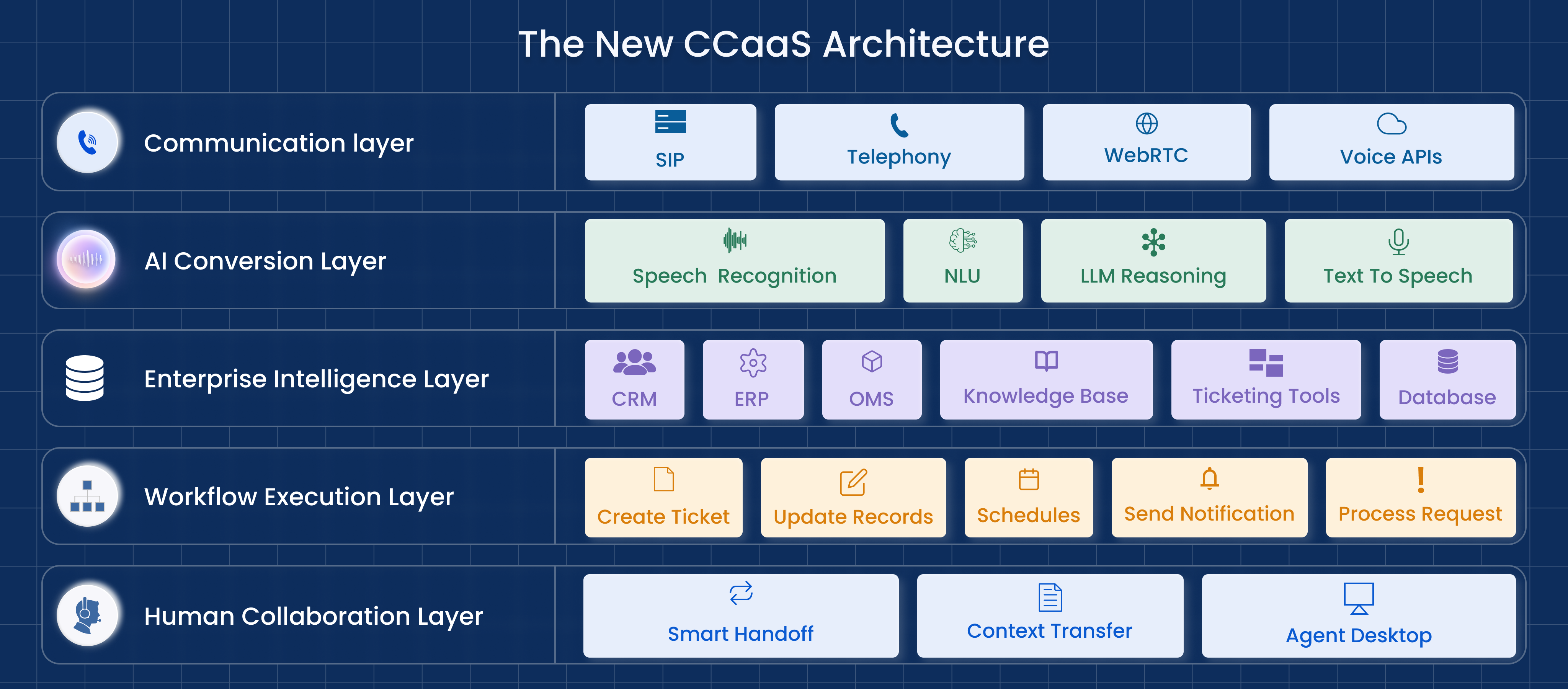
AI voice agents are changing the architecture of Contact Center as a Service platforms.
Traditional CCaaS platforms typically include:
- Telephony
- IVR
- Call queues
- Agent desktops
- Call recording
- CRM integration
- Reporting dashboards
The next generation adds an intelligent AI layer across the entire ecosystem.
A modern AI-powered CCaaS architecture may include:
Communication Layer
This includes SIP, telephony infrastructure, cloud communications, WebRTC, and voice APIs.
AI Conversation Layer
This layer handles:
- Speech recognition
- Natural language understanding
- LLM reasoning
- Conversation management
- Text-to-speech
Enterprise Intelligence Layer
The AI agent connects with:
- CRM platforms
- ERP systems
- Ticketing tools
- Knowledge bases
- Customer databases
- Order management systems
Workflow Execution Layer
This layer enables the AI to perform actions through APIs and business logic.
Examples include:
- Creating support tickets
- Updating customer records
- Scheduling appointments
- Processing service requests
- Sending notifications
- Initiating workflows
Human Collaboration Layer
When an interaction becomes complex, sensitive, or high-value, the AI voice agent can transfer the call to a human agent along with relevant context.
The customer does not need to repeat the entire conversation.
AI Voice Agents Are Moving Beyond First-Level Support
One of the biggest misconceptions about conversational AI is that voice agents are limited to answering basic FAQs.
In reality, AI voice agents are increasingly being used across multiple stages of customer engagement.
Customer Support
AI voice agents can manage the following:
- Order tracking
- Account questions
- Billing inquiries
- Appointment changes
- Technical troubleshooting
- Service requests
Sales and Lead Qualification
Voice AI can engage inbound leads immediately, ask qualifying questions, identify requirements, and route high-value prospects to sales teams.
This is especially valuable for businesses where response speed directly affects conversion rates.
A lead that receives an immediate response is more likely to continue the conversation than one that waits several hours for a callback.
Outbound Calling
AI voice agents can support the following:
- Customer follow-ups
- Appointment reminders
- Payment reminders
- Lead nurturing
- Feedback collection
- Renewal campaigns
The advantage is scale. A human team can make only a limited number of calls in a day. An AI voice platform can manage thousands of conversations simultaneously, subject to applicable regulations and business requirements.
Context Is Becoming the Competitive Advantage
The future of AI voice agents is not simply about making conversations sound human.
The real advantage is context.
A voice agent should understand:
- Who the customer is
- What they previously discussed
- Their current issue
- Their account history
- Their relationship with the business
For example, if a customer has already spoken to a chatbot, sent an email, and then calls the contact center, the voice agent should ideally have access to that interaction history.
This creates an omnichannel customer experience instead of isolated conversations.
The goal is simple:
The customer should not have to start from zero every time they change channels.
This is where AI voice agents, CRM systems, customer data platforms, and knowledge systems come together.
RAG and Enterprise Knowledge for More Accurate Voice AI
One of the biggest challenges in enterprise AI is accuracy.
A general-purpose language model may know a lot about the world, but it does not automatically know a company's internal policies, product catalog, pricing rules, or support procedures.
This is where Retrieval-Augmented Generation (RAG) becomes important.
With RAG, an AI voice agent can retrieve relevant information from trusted enterprise sources before generating a response.
For example:
A customer asks:
“Can I return this product after 45 days?”
The AI agent can retrieve the company's current return policy and provide an answer based on approved business information.
This helps reduce hallucinations and improves response accuracy.
For enterprise contact centers, RAG can connect AI voice agents with:
- Internal knowledge bases
- Product documentation
- SOPs
- Policy databases
- FAQs
- CRM records
This makes the voice agent more useful in real-world business environments.
AI Voice Agents and Human Agents: Collaboration, Not Replacement
The most effective contact center strategy is unlikely to be completely human or completely automated.
It will be hybrid.
AI voice agents are highly effective at handling:
- Repetitive questions
- High-volume interactions
- Basic transactions
- Data collection
- Routine follow-ups
Human agents remain essential for:
- Emotional conversations
- Complex complaints
- Negotiations
- High-value customers
- Sensitive cases
- Strategic decision-making
The AI handles the repetitive workload, while human agents focus on interactions that require empathy, judgment, and expertise.
This can improve both customer experience and employee experience.
Instead of spending an entire shift answering the same basic questions, human agents can spend more time solving meaningful problems.
Real-Time Agent Assist Is Another Major Shift
AI is not only becoming the customer-facing voice.
It is also becoming the assistant behind the human agent.
During a live call, AI can:
- Transcribe the conversation
- Identify customer intent
- Recommend responses
- Search knowledge bases
- Summarize the interaction
- Detect sentiment
- Suggest next-best actions
This is known as "Agent assist" technology.
For example, if a customer asks a technical question during a call, the AI can instantly search the company's knowledge base and provide the human agent with a relevant answer.
The agent remains in control, but AI reduces the time required to find information.
Measuring the Business Impact
AI voice agents are changing how contact center performance is measured.
Traditional metrics include the following:
- Average Handle Time
- First Call Resolution
- Service Level
- Abandonment Rate
- Customer Satisfaction
AI-powered contact centers can add new metrics, such as:
- AI containment rate
- Automation success rate
- Intent recognition accuracy
- Workflow completion rate
- Transfer quality
- AI resolution rate
The goal should not simply be to maximize automation.
A better objective is to measure whether the customer received the right outcome efficiently.
An AI agent that handles a call quickly but fails to resolve the issue is not successful automation.
Security and Compliance Cannot Be an Afterthought
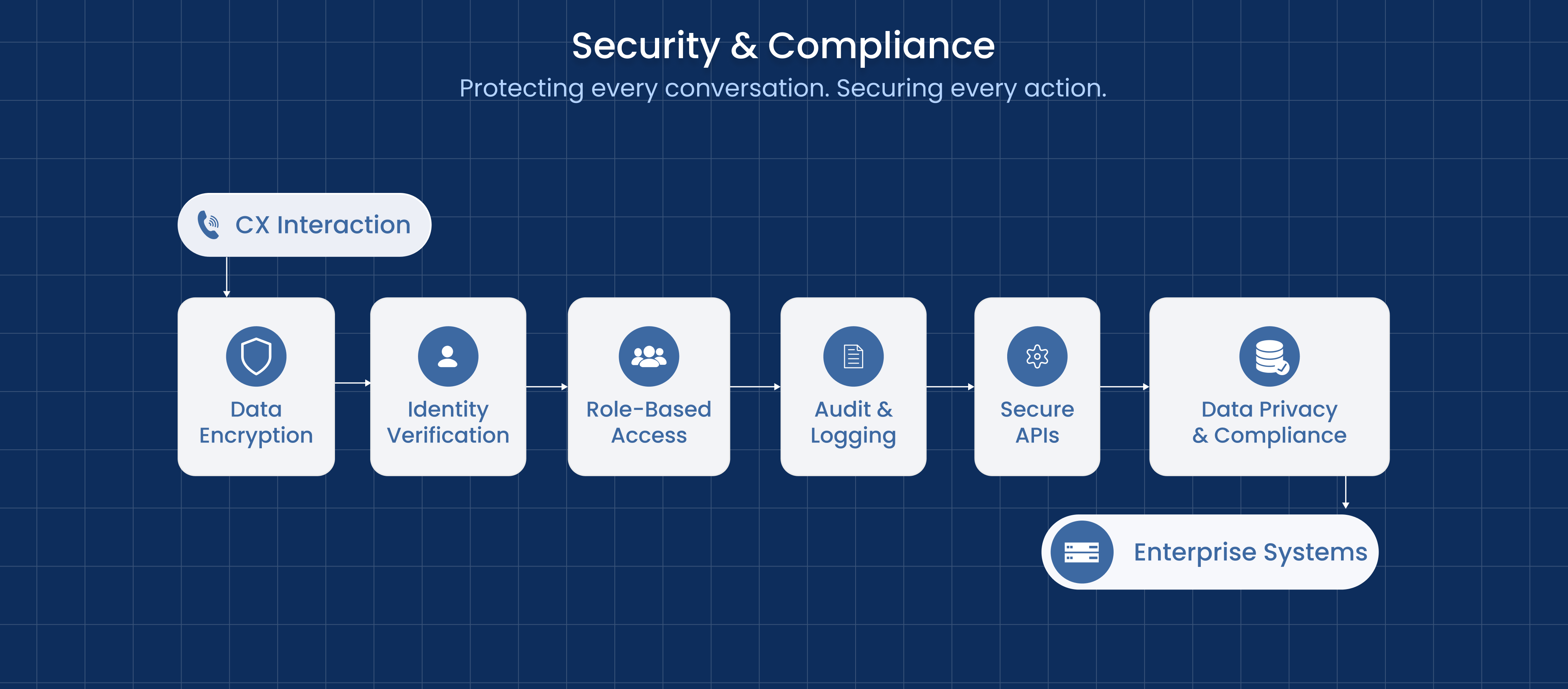
Enterprise AI voice platforms handle sensitive customer information. Security must therefore be built into the architecture.
Important areas include:
- Data encryption
- Identity verification
- Access controls
- Call recording policies
- PII protection
- Audit trails
- Data retention controls
Organizations must also consider industry-specific regulations and regional privacy requirements.
AI voice agents should not have unrestricted access to enterprise systems. Permission-based access and controlled API workflows are essential.
The principle should be
The AI can only access and perform what it is authorized to access and perform.
The Future of CCaaS Is Becoming More Autonomous
The next generation of CCaaS platforms will not simply be cloud-based contact centers.
They will become intelligent operating systems for customer conversations.
AI voice agents will increasingly:
- Understand customer intent
- Predict customer needs
- Execute business workflows
- Coordinate across systems
- Work across voice and digital channels
- Collaborate with human agents
- Learn from operational feedback
The contact center will evolve from a cost center into an intelligent customer operations platform.
The most advanced systems will not wait for customers to ask every question. They will proactively identify opportunities to support, engage, and retain customers.
Final Thoughts
AI voice agents are reshaping CCaaS platforms because they address a fundamental limitation of traditional contact centers: humans should not be required to manually manage every repetitive conversation.
Modern AI voice technology combines speech recognition, large language models, RAG, workflow automation, APIs, and enterprise integrations to create systems that can understand conversations and take meaningful action.
The most important shift is not that AI can now speak.
It is that AI can listen, understand, reason, access information, execute workflows, and collaborate with people.
For enterprises, this creates a new opportunity to build contact centers that are more scalable, responsive, intelligent, and personalized.
The future of CCaaS will not be defined by how many calls a contact center can handle.
It will be defined by how intelligently every conversation is managed.
FAQ’s
1. How are AI voice agents transforming CCaaS platforms?
AI voice agents transform CCaaS platforms by automating conversations, understanding customer intent, executing workflows, accessing enterprise data, and intelligently escalating complex interactions to human agents.
2. What technologies power AI voice agents in modern contact centers?
Modern AI voice agents use automatic speech recognition, large language models, natural language understanding, text-to-speech, RAG, APIs, and workflow orchestration technologies.
3. Can AI voice agents replace human contact center agents?
AI voice agents can automate repetitive interactions, but human agents remain essential for complex complaints, emotional conversations, negotiations, sensitive cases, and strategic customer relationships.
4. How do AI voice agents integrate with existing CCaaS systems?
AI voice agents integrate with CCaaS platforms through APIs, telephony systems, CRM software, knowledge bases, ticketing platforms, and enterprise workflows for seamless automation.
5. What are the benefits of AI voice agents for enterprises?
AI voice agents help enterprises scale customer support, reduce repetitive workloads, improve response times, automate workflows, increase operational efficiency, and deliver personalized customer experiences.


