

An AI voice agent can sound intelligent.
It can speak naturally. Understand questions. Even impress everyone during a demo.
But here’s the real test:
What happens when the customer interrupts it, the CRM fails, the call quality drops, or the AI doesn’t know the answer?
That’s where intelligence alone stops being enough.
A reliable AI voice agent needs more than a powerful model. It needs the right systems working together consistently.
1. Smart answers mean nothing if they arrive too late
A voice conversation cannot feel like email.
Customer: “Can you check my order status?”
Voice Agent: thinking.. thinking..
Even a correct answer can create a poor experience if the response takes too long.
What reliability requires:
- Fast speech recognition
- Low-latency AI processing
- Quick API responses
- Efficient text-to-speech
- Smooth interruption handling
Simple example:
The customer interrupts the voice agent midway and says, “Wait, I actually want to cancel the order.”
A reliable system should stop, understand the new request, and adapt, not continue reading the previous response.
2. “I Don’t Know” is better than a confident wrong answer.
One of the biggest challenges in enterprise AI is hallucination.
An AI should never invent:
- Return policies
- Pricing
- Account details
- Payment information
- Appointment availability
Example:
Customer: “Can I get a refund after 45 days?”
A poor voice agent might confidently say, “Yes.”
A reliable voice agent should:
- Check the latest company policy.
- Retrieve verified information.
- Answer based on approved data.
- Escalate if information is unavailable.
Reliability means knowing when not to guess.
3. Real business data should be the source of truth
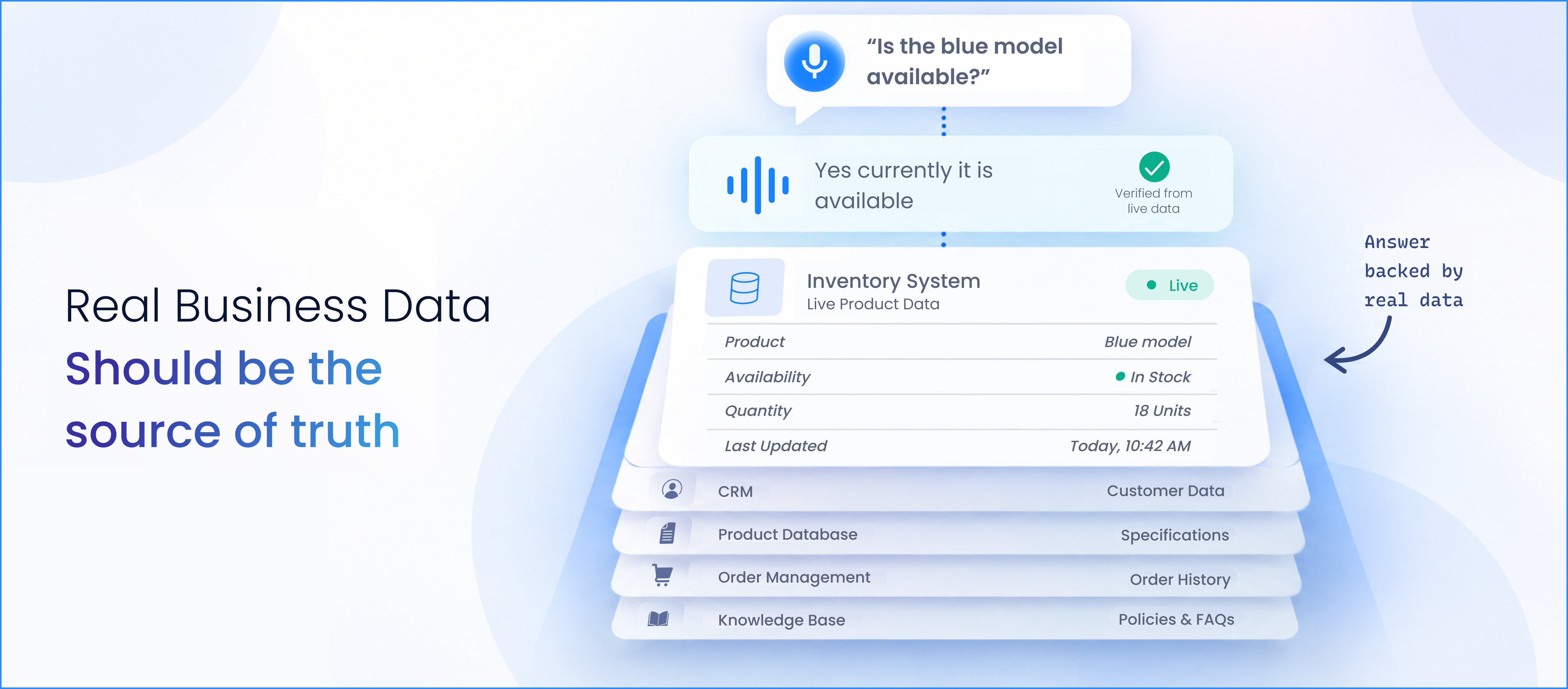
Business information changes constantly.
Yesterday's information may not be valid today.
That's why enterprise Voice Agents should connect with systems such as:
- CRM
- ERP
- Knowledge bases
- Inventory systems
- Scheduling platforms
- Helpdesk tools
Example:
A customer asks:
“Is the blue model available?”
Instead of generating an answer based on old information, the voice agent should check the live inventory system.
AI intelligence interprets the question. Business data provides the answer.
4. A voice agent must do more than talk.
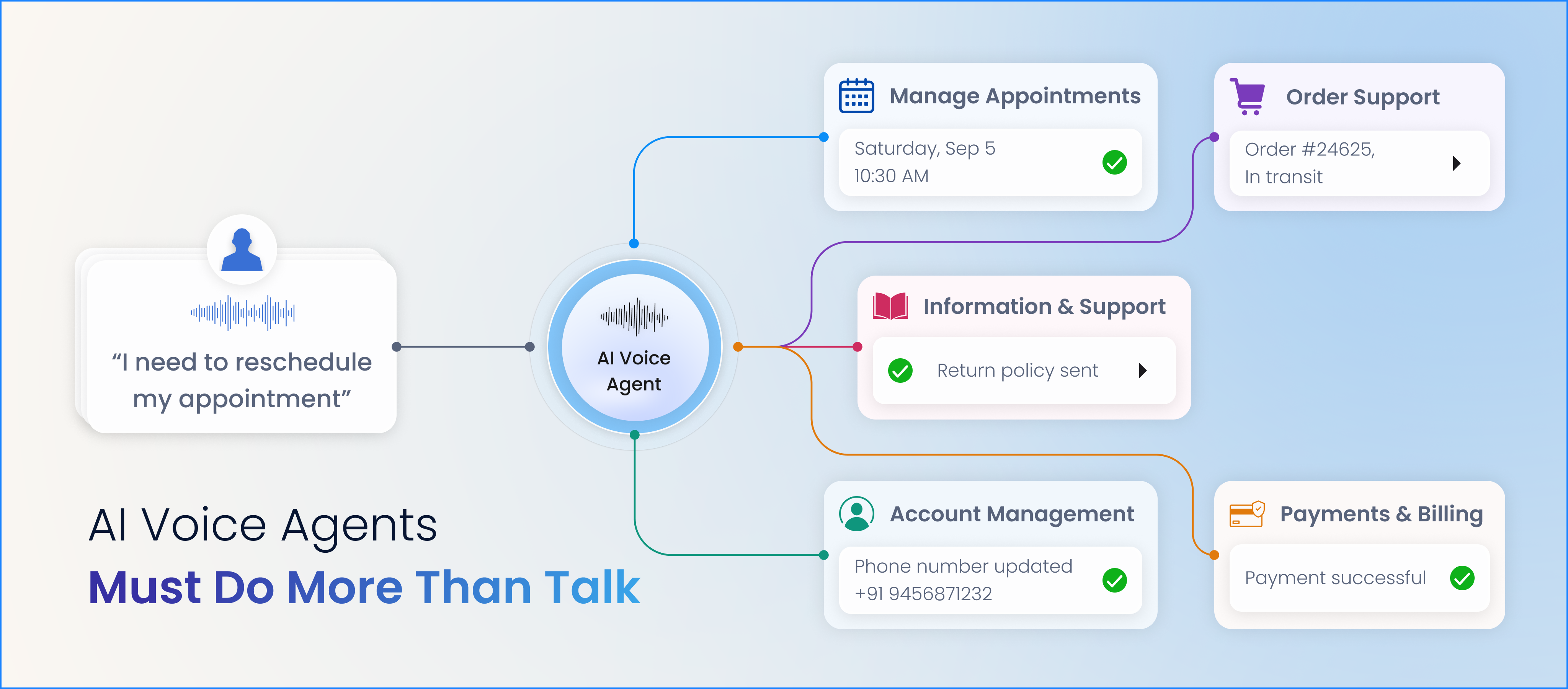
A good conversation is useful.
A completed task is valuable.
Example:
Customer: “Please move my appointment to Friday.”
The voice agent should not simply say:
“Sure, you can change your appointment.”
It should ideally:
- Check available slots
- Confirm the preferred time
- Update the booking system
- Send confirmation
That is the difference between a conversational AI and an action-oriented voice agent.
5. What If One System Stops Working?
This is where real-world reliability matters.
Imagine the voice agent is working perfectly, but the appointment system is temporarily unavailable.
A poor system might:
❌ Give an error
❌ End the call
❌ Keep repeating itself
A reliable system can:
✓ Detect the failure
✓ Retry the connection
✓ Offer an alternative
✓ Create a callback request
✓ Transfer to a human agent when required
Technology will occasionally fail. Reliable systems are designed for what happens next.
6. Human Handover Should Not Feel Like Starting Over
Everyone knows this frustrating experience:
“Please explain your issue to the next agent.”
Again?
A reliable voice agent should pass useful context during escalation.
The human agent should receive:
- Customer details
- Reason for calling
- Conversation summary
- Actions already taken
- Relevant account information
Example:
Instead of: Human Agent: “How can I help you?”
The experience can become:
Human Agent: “I can see you're calling about your delayed order. Let's continue from there.”
That is not just automation. That is intelligent collaboration.
7. High Call Volume Is Where the Real Test Begins
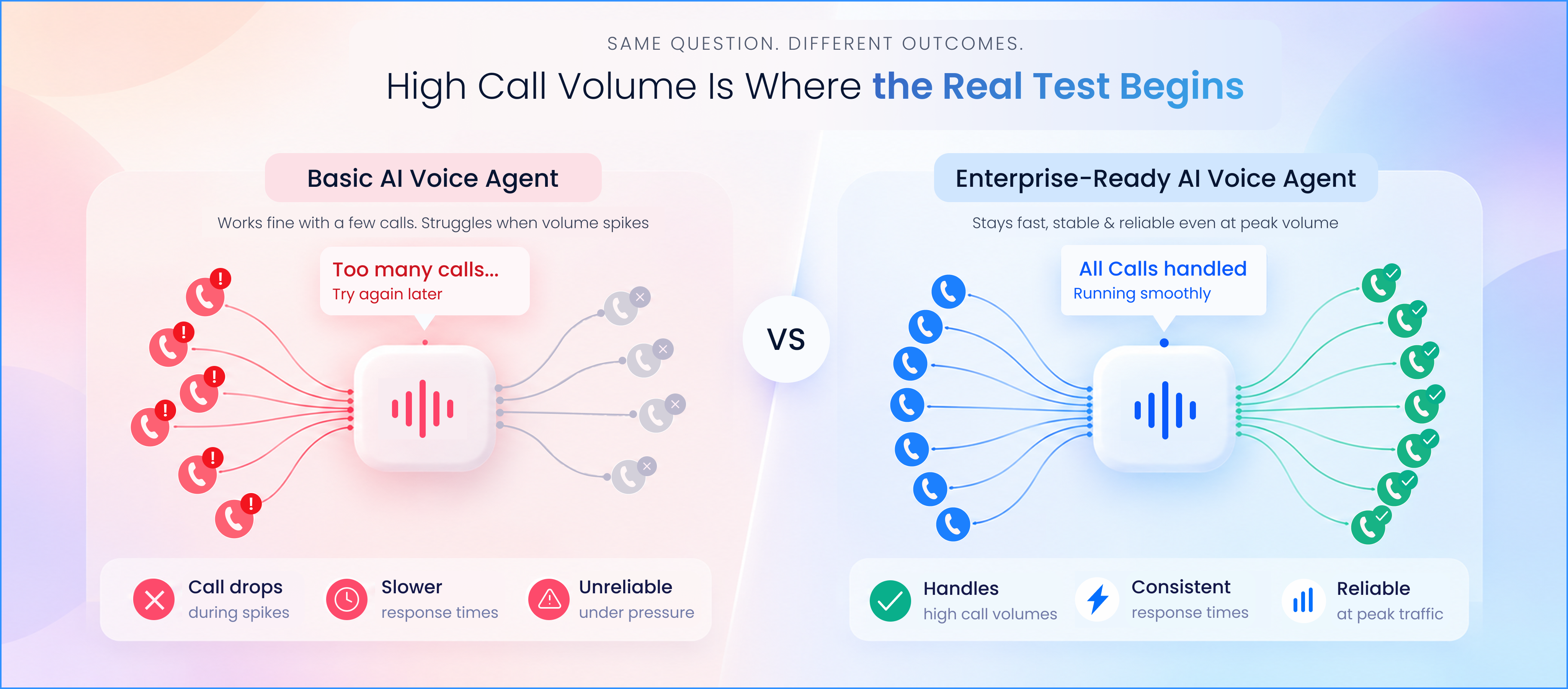
A voice agent might perform perfectly with 10 calls.
But what about:
- 1,000 calls?
- 10,000 calls?
- A sudden campaign response?
- Peak holiday traffic?
Enterprise reliability requires systems that can scale.
Key requirements:
- Scalable infrastructure
- Load balancing
- Performance monitoring
- Failover mechanisms
- Capacity planning
The question isn't “Can the AI make a call?”
It's:
“Can the business depend on it when everyone calls at once?”
8. Monitor What the Customer Actually Experiences
You cannot improve what you cannot see.
A reliable voice AI platform should track more than just the number of calls.
Monitor:
Were calls completed?
How quickly did the agent respond?
Did it understand customer intent?
Was the issue resolved?
How often did calls require escalation?
Which workflows failed?
Example:
If customers repeatedly ask for human support after hearing the same response, the issue may not be AI intelligence.
The problem could be the conversation design.
Data helps identify that.
9. Security Should Not Be Added at the End
Voice agents can access sensitive information.
So access must be controlled.
A reliable enterprise system should consider:
- Authentication
- Data encryption
- Role-based access
- Permission controls
- Audit logs
- Controlled data access
Example:
A voice agent checking an appointment may need access to booking details.
It does not necessarily need access to the customer's entire financial history.
Give the AI access to what it needs, not everything it can reach.
10. The Best Voice Agents Know When to Stop
Reliability is not about automating 100% of conversations.
Sometimes the best decision is escalation.
Examples where human support may be better:
- Highly emotional conversations
- Complex complaints
- Sensitive decisions
- Repeated failed attempts
- Requests outside defined policies
The goal should not be:
“Make the AI handle everything.”
The goal should be:
“Make sure every customer gets the right outcome.”
So, What Actually Makes a Voice Agent Reliable?
A reliable enterprise AI voice agent needs this combination:
Intelligence - Understands conversations
Speed - Responds naturally
Accuracy - Uses trusted information
Integration - Connects with business systems
Action - Completes workflows
Security - Protects sensitive information
Scalability - Handles growing call volumes
Human Handoff - Escalates intelligently
Final Thoughts
The future of AI voice agents is not about finding the model that sounds the smartest.
It is about building a system businesses can trust.
Because customers don't care whether your AI uses the latest LLM.
They care about one thing:
“Did it actually solve my problem?”
And when the answer is consistently YES, that's when AI becomes truly reliable.
FAQ's
1. Why is reliability important for AI voice agents?
Reliability ensures AI voice agents consistently understand customers, provide accurate information, handle failures gracefully, execute workflows safely, and deliver dependable experiences during real-world interactions.
2. What makes an enterprise AI voice agent reliable?
A reliable voice agent combines low latency, accurate speech recognition, trusted data sources, resilient infrastructure, secure integrations, monitoring, error handling, and intelligent human escalation capabilities.
3. How can AI voice agents avoid providing incorrect information?
AI voice agents can use RAG, real-time business integrations, verified knowledge sources, confidence thresholds, and human escalation to reduce incorrect or unsupported responses significantly.
4. What happens when an AI voice agent cannot solve a problem?
The agent should recognize uncertainty, avoid guessing, collect relevant context, and seamlessly transfer the customer to a qualified human agent for further assistance.
5. Can AI voice agents remain reliable during high call volumes?
Yes, scalable cloud infrastructure, load balancing, monitoring, failover systems, and efficient architecture help enterprise AI voice agents handle increasing conversation volumes reliably.


